
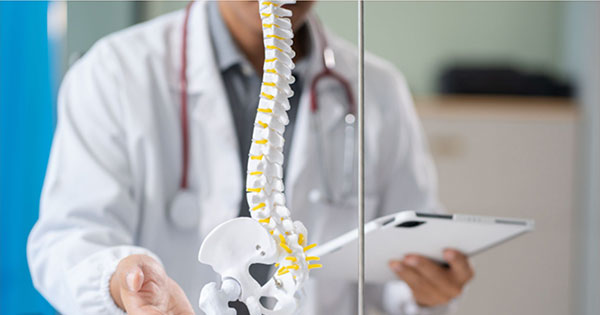
Most people know smoking is hard on the heart and lungs. Far fewer realize it can also affect the discs, bones, and nerves that keep your spine working. If you live with back or neck pain, or you are considering spine surgery, tobacco may be quietly working against you. The good news is that quitting can help. Here is what research tells us about smoking and your spine.
How Smoking Affects Your Spinal Discs
Your spinal discs act as cushions between the vertebrae. They have a limited blood supply, so they depend on nutrients slowly reaching them from nearby tissue. A classic study of identical twins, in which one twin smoked and the other did not, found about 18% greater disc degeneration scores in the lower spines of the smokers.1 Because twins share their genes, this comparison helps isolate the effect of smoking. The changes appeared across the whole lumbar spine, which suggests smoking acts throughout the body rather than in one spot.1 Over time, wear like this may contribute to degenerative disc disease.
The Link Between Smoking and Back Pain
Smoking is also associated with back pain itself. A large analysis of 40 studies found that current smokers were more likely to report low back pain, including chronic and disabling back pain, than people who had never smoked.2 The researchers described the association as fairly modest, but it was consistent.2 Former smokers fell in between, with less back pain than current smokers.2
Nerve pain follows a similar pattern. Another analysis found that current smokers had a higher risk of lumbar radicular pain and sciatica, and that quitting appeared to reduce, though not fully erase, that extra risk.3 These studies show associations rather than proof of cause, but together they point in the same direction.
Why Smoking Makes Spinal Fusion Harder
Spinal fusion surgery relies on your body growing new bone to join two or more vertebrae into one solid unit. Smoking can interfere with that healing. Reviews of the research report that smoking significantly increases the risk of pseudarthrosis, which means the bones fail to fuse, in both lumbar fusion and cervical fusion.4,5 Smoking has also been linked with higher rates of infection, problems at neighboring spinal levels, and trouble swallowing after neck surgery.4
One study of 357 patients who had lower back fusion found that the nonunion rate was 14.2% for nonsmokers compared with 26.5% for people who continued to smoke after surgery.6 Among those who quit for more than six months after surgery, the rate was 17.1%, and their return to work was similar to nonsmokers.6 A fusion that does not heal can sometimes lead to ongoing pain and further surgery, a situation sometimes described as failed back surgery.
Smoking and Healing After Any Spine Procedure
Healing an incision depends on oxygen, blood flow, and a strong immune response. A major review of wound healing found that smoking temporarily lowers tissue oxygen and impairs the cells that fight infection and repair tissue.7 Encouragingly, the same review found that quitting restores tissue oxygen quickly, and the infection fighting response recovers partly within about four weeks.7 Whether you are planning an anterior cervical discectomy and fusion or a smaller procedure, giving your tissues the best chance to heal matters.
What We Ask Before and After Surgery
As our guide to preparing for spine surgery explains, not smoking is one of the ways we ask you to prepare your body for surgery. Our recovery and aftercare guidance also asks you to avoid smoking while you heal. If surgery is on your horizon, let us know about any tobacco use early so we can plan together. Research suggests that the duration and timing of quitting both matter, so an early start may help.5
Quitting Is Worth It at Any Stage
It is never too late to benefit. Studies suggest that former smokers have less back pain and sciatica risk than current smokers, and that quitting around surgery can reduce complications.2,3,5 Even if surgery is not in your plans, stopping tobacco supports your discs and your overall health. Your primary care provider can help you find support to quit, and we are glad to discuss alternatives to back surgery as part of your care.
Frequently Asked Questions
Does smoking really cause back pain?
Smoking is linked with back pain, although it is not the only cause. Research shows that current smokers report more low back pain than people who have never smoked, and that the association is modest but consistent.2
Can smoking damage my spinal discs?
Research suggests it can speed up disc wear. In a study of identical twins, the twin who smoked had more disc degeneration than the twin who did not.1
Will you operate if I smoke?
We will discuss your situation with you individually. Not smoking is part of how we ask you to prepare for surgery, because smoking can raise the risk that a fusion will not heal.4,5
How long should I stop smoking before spine surgery?
There is no single timeline that fits everyone, so we will give you guidance for your situation. Research suggests that both how long and when you quit can affect your risk of complications.5
Does quitting after surgery still help?
Yes, it appears to. In one fusion study, people who quit for more than six months after surgery had lower nonunion rates than those who kept smoking.6
Take the First Step Toward a Healthier Spine
Your spine works hard for you every day, and protecting it is one of the best investments you can make. If back or neck pain is affecting your life, or you want to talk about how smoking may affect your treatment, you can request an appointment with us to start the conversation.
Reference Links:
- Smoking and lumbar intervertebral disc degeneration: an MRI study of identical twins - PubMed
- The association between smoking and low back pain: a meta analysis - PubMed
- The effect of smoking on the risk of sciatica: a meta analysis - PubMed
- The effect of smoking on spinal fusion - PubMed Central
- The effects of smoking and smoking cessation on spine surgery: a systematic review of the literature
- The effect of cigarette smoking and smoking cessation on spinal fusion - PubMed
- Wound healing and infection in surgery: the pathophysiological impact of smoking, smoking cessation, and nicotine replacement therapy: a systematic review - PubMed
AUTHOR:Payam Moazzaz, MD – Board-Certified & Fellowship-Trained Orthopedic Spine Surgeon
Payam Moazzaz, MD is a board-certified and fellowship-trained orthopedic spine surgeon specializing in the diagnosis and treatment of complex spine disorders. With over a decade of experience, he provides comprehensive care for conditions including spinal cord tumors, spinal infections, spinal deformities, spinal instability, sciatica, and degenerative spine disease. Practicing in San Diego, Dr. Moazzaz is dedicated to restoring mobility, reducing pain, and helping patients return to active, fulfilling lives.
Credentials & Leadership
Dr. Moazzaz is recognized as an industry leader in robotic spine surgery in California. He was among the first physicians in the United States to perform robotic spine surgery and has completed more robotic spinal procedures than any other surgeon in San Diego and throughout California. He has performed hundreds of robotic spine surgeries with excellent patient outcomes and regularly hosts visiting surgeons from across the United States and internationally to teach advanced robotic techniques.
Clinical Expertise
Dr. Moazzaz specializes in minimally invasive and robotic-assisted spine surgery, including spinal fusion, scoliosis correction, discectomy, laminectomy, spinal trauma surgery, and procedures addressing complex spinal instability. Using advanced 3D imaging and robotic guidance systems, he performs surgery through small incisions with enhanced precision, reduced tissue disruption, and optimized implant placement.
In addition to surgical care, Dr. Moazzaz offers a full spectrum of noninvasive and nonsurgical treatment options, including medication management, physical therapy, injections, and other specialty procedures. When conservative therapies are not effective, he carefully guides patients through advanced surgical options with a focus on safety, precision, and faster recovery.
Dr. Moazzaz’s philosophy centers on individualized treatment planning, patient education, and compassionate care. His goal is not only to relieve pain but to restore function and empower patients to resume work, recreation, and daily activities with confidence.
Medical Disclaimer: This information is for educational purposes only and does not constitute medical advice. For diagnosis and treatment recommendations, please consult with Dr. Moazzaz or another qualified spine specialist.
Content authored by Dr. Payam Moazzaz and verified against official sources.